Answers to What Greeley Homeowners Actually Ask About Insulation
These are the questions that come up on nearly every insulation call in Greeley and Weld County, answered the way we would answer them on the phone. Costs, R-values, foam versus blown-in, rebates, and the uncomfortable ones about mice and red flags.
If a question here does not cover your building, the resource library goes deeper, and the individual service pages carry their own FAQs. Or just call and ask.
Question not answered below? Call (970) 414-2650
Common insulation questions in Greeley and Weld County
How much does insulation cost in Greeley, CO?
Most residential jobs land between $1,500 and $6,000. A blown-in attic taken to R-49 or R-60 typically runs $1,500 to $4,000. Attic air sealing runs $350 to $1,500. Crawl space work runs $1,500 to $6,000, and garage insulation runs $800 to $3,500.
Those are typical Northern Colorado ranges, not quotes. Square footage, access, and whether old material has to come out first drive the spread.
How much does attic insulation cost in Greeley, CO?
Blown-in attic insulation runs about $1.00 to $2.80 per square foot installed. On an average Greeley ranch with 1,200 to 1,600 square feet of attic floor, that is roughly $1,600 to $3,500 to go from R-19 up to R-49. Air sealing first adds $350 to $900 and is worth doing in the same visit.
What is the recommended R-value for an attic in Colorado?
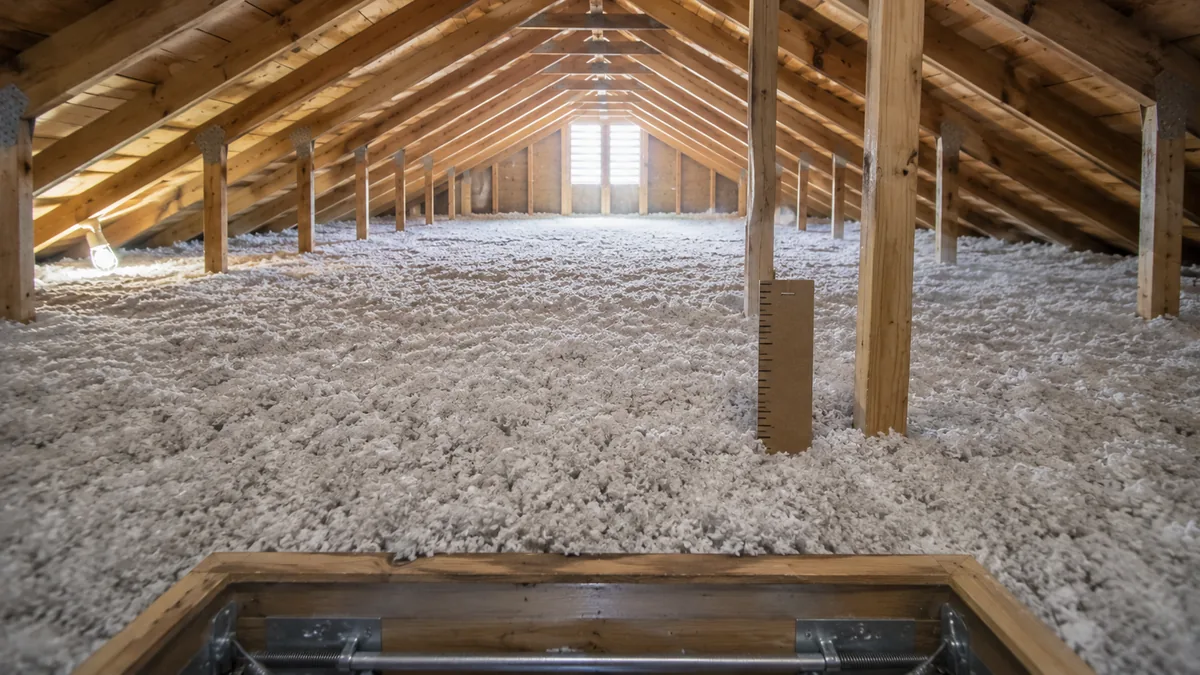
Greeley sits in DOE climate zone 5B, where the attic recommendation is R-49 to R-60. That is roughly 14 to 20 inches of blown material depending on the product. Many pre-1980 Weld County attics measure R-19 or less. The Department of Energy insulation guidance publishes the zone map.
How do I tell what R-value my attic has right now?
Open the hatch and measure the depth with a tape. Blown fiberglass gives roughly R-2.5 per inch, blown cellulose roughly R-3.5 per inch, and fiberglass batts roughly R-3.2 per inch. Ten inches of blown fiberglass is about R-25. If you can see the tops of the ceiling joists, you almost certainly have less than R-30.
Is blown-in or spray foam better for my attic?
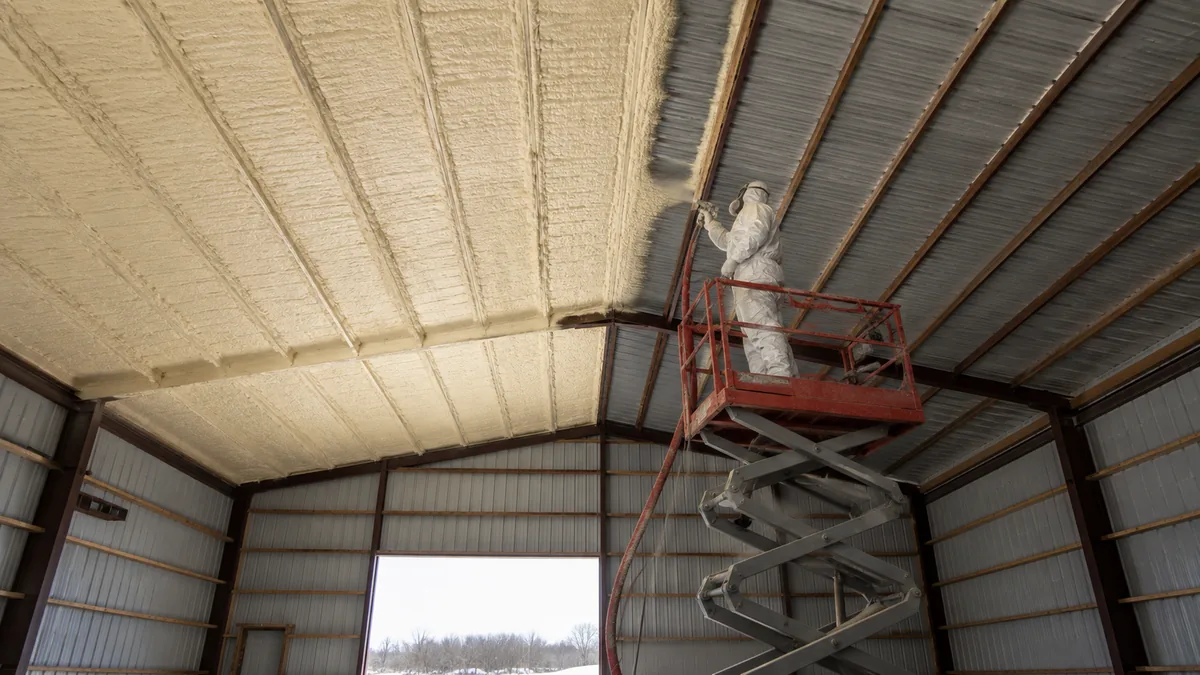
For a flat, open, vented attic floor, blown-in gives you more R-value per dollar and there is no good reason to spend foam money there. Spray foam wins where you need air sealing and structure in one pass: rim joists, crawl space walls, knee walls, vaulted roof decks, and metal buildings.
Most Weld County houses end up with both, foam at the leak points and blown-in over the flat.
What is the difference between open cell and closed cell spray foam?
Closed cell is denser and delivers R-6.5 to R-7 per inch, acts as its own vapor retarder, and adds rigidity to the assembly. Open cell delivers R-3.5 to R-3.7 per inch, stays soft, and lets vapor pass. Closed cell costs $1.00 to $1.50 per board foot installed, open cell $0.45 to $0.75.
Use closed cell where depth is limited or moisture matters. Use open cell where you have room and want the cheaper air seal.
What are the downsides of blown-in insulation?
It settles over time, so the depth you buy is not the depth you have in fifteen years. It does not stop air movement on its own, so an unsealed attic still leaks. It can be blown unevenly by a rushed crew, and it is easy to bury a bathroom fan or a can light that should have been sealed and dammed first.
None of that makes it a bad product. It makes prep and depth verification the part that matters.
Why is spray foam insulation sometimes called a red flag?
Because bad installs are genuinely bad, and a few real failure modes got amplified online. The real ones: foam sprayed on a wet or dirty surface does not bond and pulls away. Foam applied off-ratio can stay tacky and smell. Foam in an unvented roof assembly can trap moisture in the deck if the assembly was not designed for it.
The overblown ones: that all foam off-gasses forever, or that it always rots a roof. Cured foam applied correctly on prepared surfaces is stable. Ask any contractor how they verify surface temperature and mix ratio, and listen to whether they have an answer.
Do mice nest in blown-in cellulose?
Mice do not eat cellulose and they do not prefer it, but they will absolutely tunnel and nest in any loose insulation once they are in the attic. Borate-treated cellulose is not a rodent repellent. Fiberglass is no better.
The honest fix is sealing the entry points, which is a different job than insulating. If a walkthrough turns up droppings, be told plainly: new insulation over a live rodent problem buys you the same job again in two years.
Will new insulation stop ice dams?
Often, but only when it is paired with air sealing. Ice dams form because heat leaking into the attic melts snow on the upper roof, the water runs to a cold eave, and refreezes. Adding depth without sealing the leaks slows the heat but does not stop it.
Sometimes insulation is not the answer at all. A bath fan venting into the attic, a bypassed chimney chase, or blocked soffit vents will keep making ice dams no matter how much material you add.
Do I have to remove old insulation before adding new?
Not usually. If the existing material is dry, reasonably even, and free of droppings, new insulation goes right over it. Removal is required when there is rodent contamination, water damage from a leak or ice dam, fire or smoke damage, or vermiculite that needs testing first. Removal runs $1.00 to $2.00 per square foot.
What insulation rebates and tax credits are available in Colorado?
The federal 25C credit covers 30% of the cost of insulation and air sealing, up to $1,200 per year on your primary residence. Details are on the IRS energy efficient home improvement credit page. Xcel Energy also runs insulation rebates for its Colorado customers, and the amounts change, so check Xcel current rebate sheet before budgeting around a number.
How long does an insulation job take?
Most attic jobs finish in a day. Air sealing plus blown-in on an average Greeley house is four to seven hours. A crawl space encapsulation and foam job is one to two days. A garage is usually a day. Pole barns and shops depend on square footage, and a large metal building can run two to three days.
Do you offer financing?
Ask on the phone. Financing availability depends on the crew covering your area and it changes, so we are not going to promise a program on a web page that might not exist when you call. What we can tell you reliably is that the 25C tax credit and Xcel rebates reduce the real cost of most projects.
Can I insulate my attic myself?
You can. Rental blowers are available and the material is not expensive. What DIY jobs usually miss is the sealing work underneath, the eave baffles that keep soffit vents open, and the dams around the flue and recessed lights. Skipping those is how people end up with a well-insulated attic that still has ice dams.
Crawl spaces and spray foam are a different story. Foam is not a DIY product at any real scale.
Will more insulation actually lower my Xcel bill?
Usually yes, and the size of the change depends on where you start. Going from R-19 to R-49 in a Weld County attic is a real reduction in heating load. Going from R-49 to R-60 is a much smaller one. We will tell you which situation you are in rather than quoting a percentage we cannot back up for your house.
Is spray foam safe to be around after it is installed?
Once it is fully cured, yes. During installation and for a period after, the space needs to be vacated and ventilated, and the installers work in supplied-air respirators. The cure window depends on the product and the conditions. Any contractor who tells you that you can stand in the room during a spray is telling you something wrong.
What is the fastest, cheapest thing I can do to a drafty house?
Attic air sealing. It runs $350 to $1,500 for most Greeley houses, takes part of a day, and it addresses the chinook wind problem directly rather than just slowing conduction. If your budget only covers one thing this year, do that before adding depth.
Where to go next
For dollar figures with worked examples, read the spray foam insulation cost guide or the attic insulation cost guide. To model your own square footage, use the cost calculator.
If you already know what you need, go straight to attic insulation, spray foam, or attic air sealing.
Still have a question? Ask it on the phone
Tell us the room, the square footage, and what it is doing wrong. You get a straight price range on the phone and a firm quote after we look at it.
Call (970) 414-2650Greeley, Evans, Windsor, Eaton, Johnstown, Milliken, Severance, and Weld County.