
Choosing Between Fiberglass and Spray Foam in Weld County
Picture two Greeley houses on the same block, both quoted for insulation the same week. One gets blown-in fiberglass for $2,400. The other gets spray foam for $7,800. Both quotes are honest. This guide explains what actually separates the two materials so you can tell which one your house, attic, crawl space, or shop should get.
What is the core difference between fiberglass and spray foam?
Fiberglass is spun glass fiber that works by trapping still air inside a fluffy mat. Spray foam is a liquid plastic that expands, hardens, and bonds to whatever it touches.
That difference produces the one distinction that matters most: fiberglass slows heat but does not stop air, while spray foam does both in a single step. Everything else about the comparison follows from that.
Air movement is why a fiberglass filled attic can still feel cold. Air that leaks around a bath fan or a top plate carries heat with it, and no amount of fluff on top of that leak changes the path.
How do fiberglass and spray foam compare on paper?
Here is the side by side. Fiberglass covers both batts and blown-in loose fill, and spray foam covers both open and closed cell.
| Property | Fiberglass | Spray foam |
|---|---|---|
| R-value per inch | R-2.2 to R-4.3 | R-3.5 to R-7 |
| Seals air by itself | No | Yes |
| Controls vapor | No | Closed cell does at about 2 in |
| Handles odd cavities | Poorly, needs careful fitting | Well, it expands into gaps |
| Removable later | Easy | Difficult, it bonds to framing |
| Typical installed cost | $1.00 to $2.80 per sq ft blown | $0.45 to $1.50 per board foot |
Notice the cost row uses different units on purpose. Fiberglass is priced by the square foot of attic floor, foam by the board foot, which is one square foot at one inch deep. Comparing them requires deciding how thick the foam needs to be first.
Want both options priced for your specific house? Call (970) 414-2650
Which material wins in a Greeley attic?
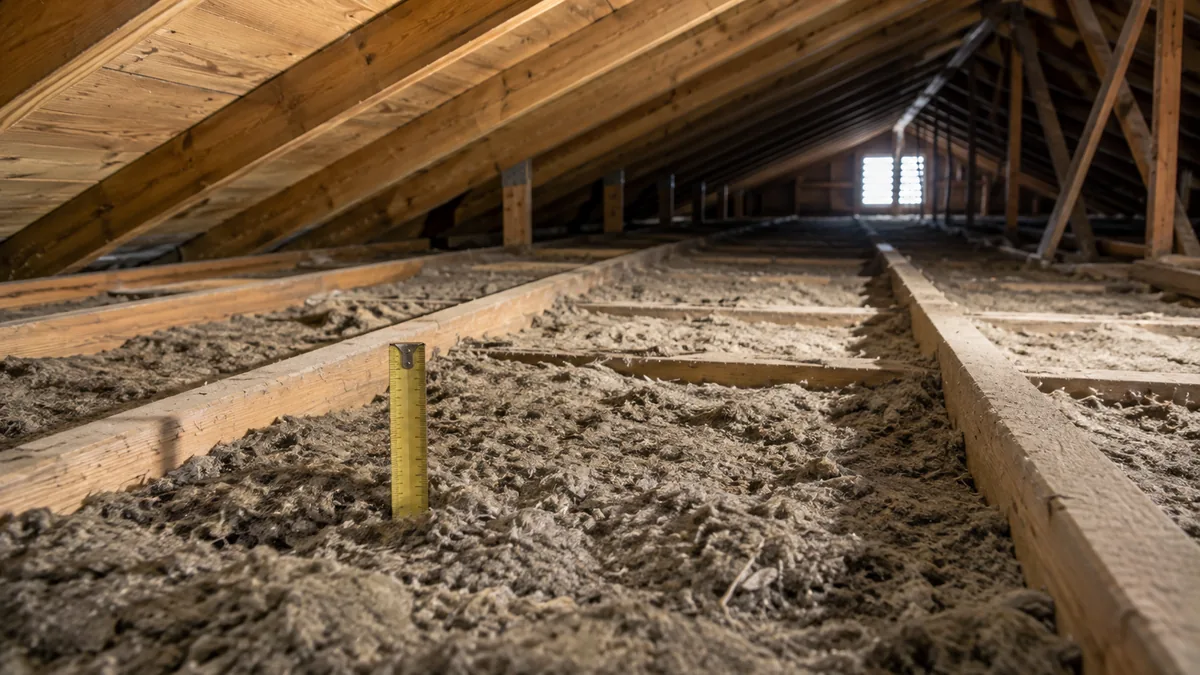
For a standard vented attic with a walkable floor, blown-in fiberglass or cellulose usually wins on value. There is unlimited depth up there, and depth is the cheapest R-value you can buy.
The pattern that works best on pre-1980 Greeley houses is a two step job: air seal the ceiling plane first, then blow the attic to R-49 to R-60. Sealing typically runs $350 to $1,500 and the attic insulation itself lands between $1,500 and $4,000 for a whole house.
Foam earns its place in an attic when the roof deck is being conditioned instead of the floor, when the ceiling is vaulted, or when ductwork and mechanical equipment live in the attic and need to be inside the thermal envelope.
Where does spray foam clearly beat fiberglass?
Four places, and they come up constantly on Weld County properties.
- Crawl spaces. Fiberglass batts stapled to floor joists sag, absorb moisture, and become rodent bedding. Closed cell foam on the crawl walls handles cold and vapor together.
- Rim joists. A short, awkward, leaky band of framing that batts never seal properly.
- Metal buildings and pole barns. Steel panels sweat all winter. Fiberglass against a sweating panel gets wet. Foam bonded to the panel ends the condensation path.
- Shallow cavities. When there are only three or four inches to work with, closed cell foam at R-6.5 to R-7 per inch is the only way to hit a real number.
Can you use both materials on one house?
Yes, and it is often the smartest budget. A flash coat of closed cell foam, typically one to two inches, handles the air and vapor job. Blown-in fiberglass or cellulose then stacks on top to reach the total R-value target at loose fill prices.
Homeowners routinely spend foam money where foam is irreplaceable, the crawl space and the rim joist, and spend blown-in money everywhere depth is free. That mix beats going all in on either material for most Greeley houses.
To see how the numbers move, run your square footage through the spray foam cost calculator and compare it against the blown-in ranges.
What about the material that is already in there?
Dry, undamaged fiberglass can usually stay and be covered. Material that is matted flat, water stained, moldy, or rodent contaminated has to come out first, which adds $1.00 to $2.00 per square foot for insulation removal.
Removal also buys something valuable: with the attic floor bare, every gap, wire penetration, and can light is visible and sealable. On a house that has never been sealed, that access is worth more than the insulation itself.
Fiberglass and spray foam questions
Is spray foam better than fiberglass?
Better at sealing air and better per inch, not better in every location. Spray foam wins in crawl spaces, rim joists, metal buildings, and shallow cathedral cavities. Fiberglass wins on an open attic floor, where depth is free and the cost per R-value is far lower.
Can you put fiberglass over spray foam?
Yes, and it is a common budget strategy. A flash coat of closed cell foam handles air and vapor control, then blown-in fiberglass or cellulose stacks on top to reach the R-49 to R-60 target for less money than foam alone.
Does fiberglass insulation stop drafts?
No. Fiberglass slows heat but air moves right through it. That is why a Greeley attic can be full of fiberglass and still feel drafty on a windy night, and why air sealing has to happen before or alongside the insulation.
Material R-values referenced from the U.S. Department of Energy insulation materials guide: energy.gov.
Get both materials priced for your project
Tell us the room, the square footage, and what it is doing wrong. You get a straight price range on the phone and a firm quote after we look at it.
Call (970) 414-2650Greeley, Evans, Windsor, Eaton, Johnstown, Milliken, Severance, and Weld County.