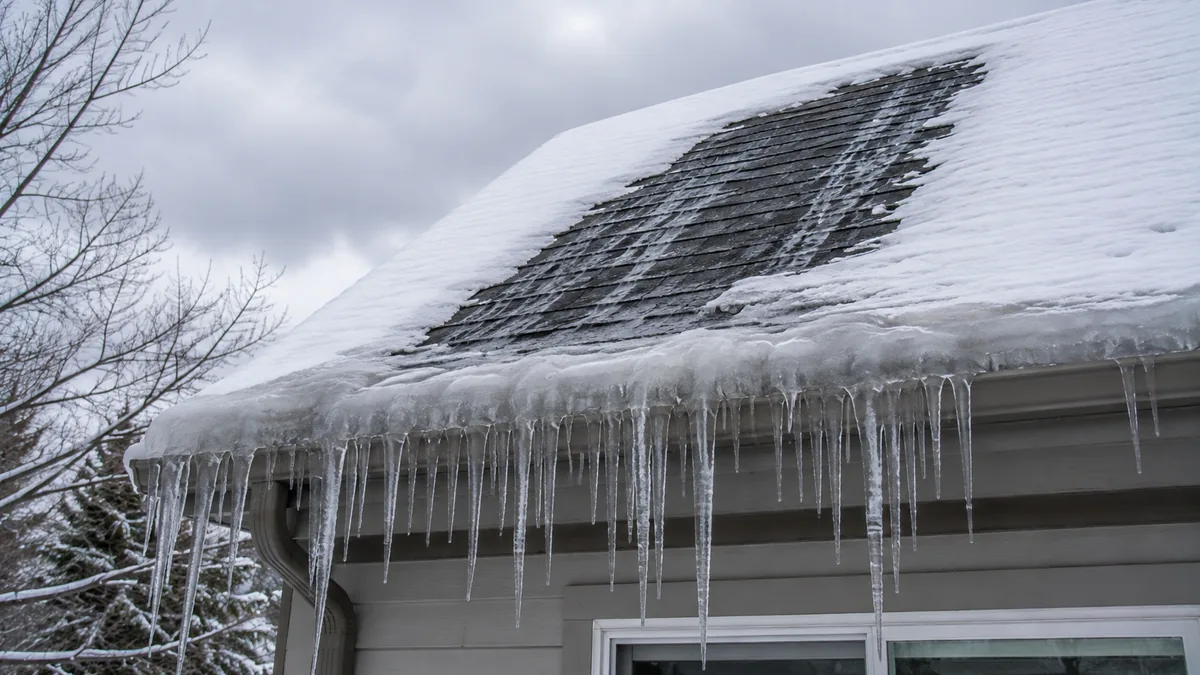
Why Greeley Roofs Grow Ice Dams, and How to Stop Them
A Greeley winter runs a specific trick: eight inches of snow on Monday, a chinook wind pushing the thermometer near sixty on Wednesday, and single digits again by Friday. Ice dams live in that swing. This article explains what causes them on Weld County houses, which fixes actually work, and which ones just move the water around.
What causes an ice dam?
An ice dam is a ridge of ice at the edge of a roof that blocks meltwater from draining. It forms when the upper roof surface is above freezing and the eave is below freezing at the same time.
Snow on the warm section melts. The water runs down, reaches the overhang where there is no heated space underneath, and refreezes. Repeat that for a few days and the ridge grows tall enough to pond water behind it.
That ponded water then works backward under the shingles, because shingles shed running water but were never designed to hold standing water. The damage shows up as ceiling stains, wet insulation, and rotted roof sheathing.
Why is the upper roof warm in the first place?
Because heated indoor air is getting into the attic. It leaves the house through gaps you cannot see from the living room: recessed light housings, the bath fan boot, the plumbing vent penetration, the attic hatch, and the top plates of every interior wall.
Warm air rises through those openings, collects at the ridge, and heats the underside of the roof deck. Wind makes it worse, because a chinook blowing across the ridge creates suction that pulls conditioned air out of the house faster.
Air leakage, not missing R-value, is the main driver of ice dams. That single fact explains why so many homeowners add insulation, see no improvement, and conclude nothing works.
Which Greeley houses get ice dams most?
Older stock leads the list. The Union Colony era neighborhoods near downtown and the blocks around UNC in 80631 were built long before air sealing was a construction step, and many of those attics still sit near R-19.
Houses with complex roofs are next: valleys, dormers, and low slope porch roofs all collect snow and slow drainage. Additions are a third pattern, because the junction where old framing meets new is almost never sealed properly.
Newer builds in west Greeley and Promontory are not immune either. Can lights and attic ductwork put heat sources above the ceiling, and a new house with thirty leaky penetrations behaves like an old one.
Seeing icicles along one edge of the roof every winter? Call (970) 414-2650
What actually fixes ice dams?
Three steps in this order, and the order matters more than any individual product.
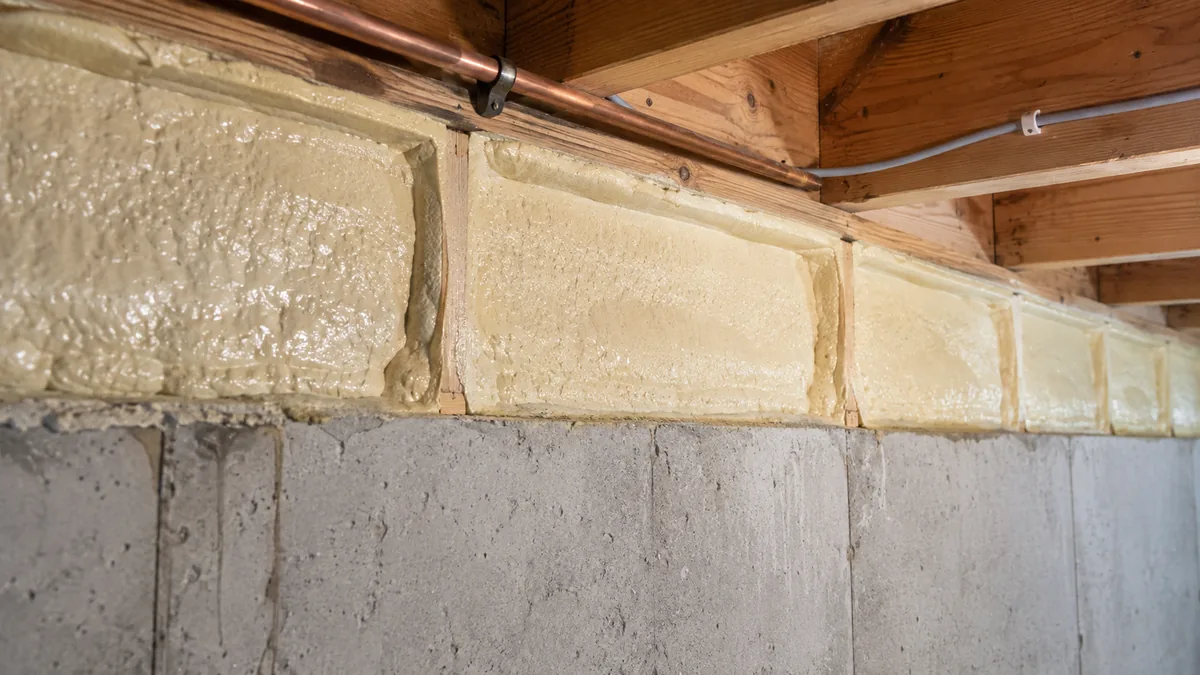
- Seal the ceiling plane. Every penetration between conditioned space and attic gets foamed or gasketed. Attic air sealing typically runs $350 to $1,500 and is the step that does the heavy lifting.
- Insulate to the Colorado target. With leaks closed, bring the attic to R-49 to R-60. An attic insulation upgrade usually lands between $1,500 and $4,000.
- Confirm the ventilation path. Soffit vents that are blocked by old insulation cannot keep the deck cold. Baffles restore the airflow from eave to ridge.
Done together, those three keep the whole roof deck at outdoor temperature. Snow that never melts never refreezes at the eave, and the dam has nothing to build from.
What about heat cables, raking, and chipping?
Heat cables cut a drainage channel through the ice. That prevents water backing up under shingles, so it protects the house, but you pay for it in electricity every cold week and the dam still forms around the channel.
Roof raking from the ground removes the snow that feeds the melt. It is a reasonable emergency measure for the lower few feet of roof, and safer than anything that involves a ladder in January.
Chipping ice with a hammer or hatchet damages shingles nearly every time, and the repair costs more than the ice ever would have. Steam removal by a qualified contractor is the safe version if a dam has to come off mid winter.
How much does the permanent fix cost in Weld County?
A combined seal and insulate project on an average Greeley house generally falls between $2,000 and $5,000, depending on attic square footage, access, and whether contaminated old material has to be removed first at $1.00 to $2.00 per square foot.
Federal 25C credits cover 30 percent of qualifying insulation and air sealing costs, up to $1,200 per year, and Xcel Energy runs rebates for Colorado customers. Both are covered in the 2026 tax credit article. Detailed line items sit in the Greeley attic insulation cost guide.
Ice dam questions from Greeley homeowners
Will new insulation stop ice dams?
Insulation alone often does not. Ice dams are driven by warm air leaking into the attic, and air moves straight through loose fill. Sealing the ceiling plane first and then insulating to R-49 to R-60 is what actually stops the melt cycle.
Are heat cables a permanent fix for ice dams?
No. Heat cables melt a channel through the ice so water can escape, which prevents backup damage, but they run on your electric bill every winter and do nothing about the cause. Treat them as a stopgap on a problem roof, not a solution.
How do I know if my ice dam is from attic heat?
Compare your roof to the neighbors after a snowfall. If your snow melts off in patches or streaks while theirs stays even, heat is escaping through the ceiling. Even snow cover across the whole roof is what a well sealed attic looks like.
Air sealing and attic ventilation guidance referenced from the U.S. Department of Energy: energy.gov.
Stop the ice dam at the source
Tell us the room, the square footage, and what it is doing wrong. You get a straight price range on the phone and a firm quote after we look at it.
Call (970) 414-2650Greeley, Evans, Windsor, Eaton, Johnstown, Milliken, Severance, and Weld County.